Dr. Quinn Denny | Published on 11/11/2025
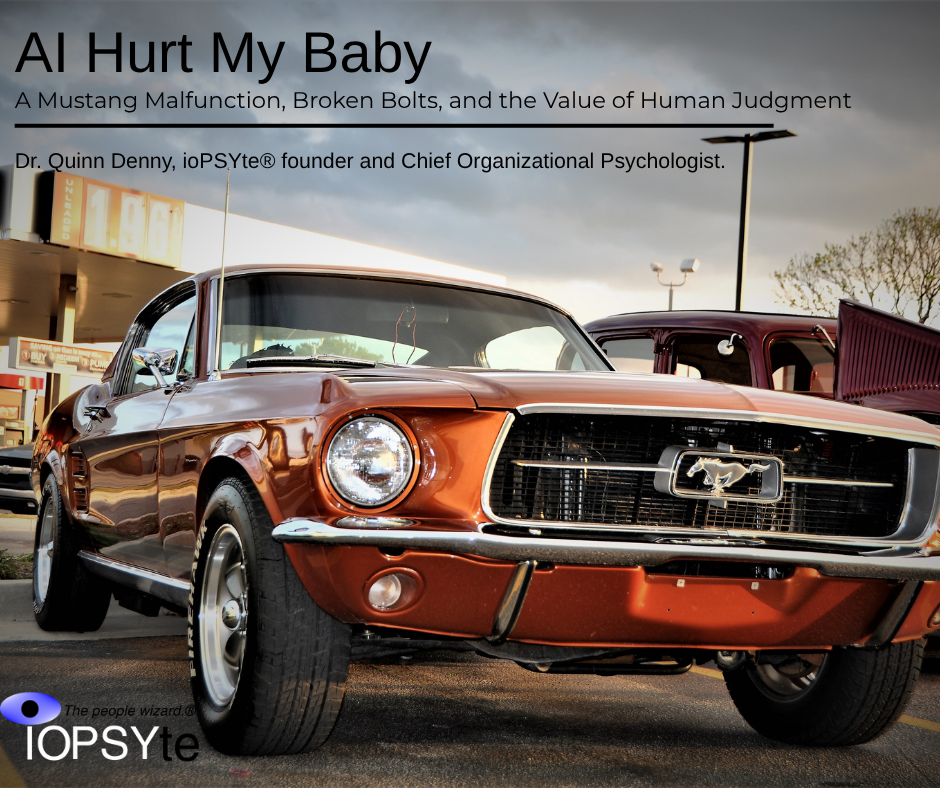 Years ago, I worked in an IT career. We had a saying, “Garbage in…garbage out”. It means that what we put into the machine we get out. If the input syntax is inaccurate it won’t work, or worse, it will produce an unwanted result. Recently, on a road trip, my Mustang broke down, and my cousin and I replaced the water pump. When sealing and attaching the new pump, we thought we would check Ford’s torque specs since tightening the bolts on the pump after sealing is key to avoiding leaks. The repair is a bit more extensive, so it makes good sense.
Guess what, I searched up the specs on my mobile with Microsoft Copilot (AI Assistant). The number it provided seemed excessive, but hey, that’s the number the machine kicked back. We set the torque and proceeded. You can probably predict where this is headed… two broken off bolts! Thankfully, in addition to being a district judge, my cousin is a master craftsman. He was able to extract one of the bolts and the other was in a position that proved non-consequential. I should have known better, not long ago I asked AI some pointed questions regarding my research in which I am an expert and what it produced was gobbledygook and completely inaccurate.
AI is as insightful as the content it draws upon and the programming it is designed with. I share because it is a solid reminder that to date nothing surpasses the brain’s capacity to perform inductive-deductive reasoning and exude creativity. We must preserve our ability to think and investigate for ourselves; this skill will undoubtedly be a prized asset in the workforce moving forward. We need to use AI with critical discretion and wise QC (Quality Check) tactics. We need human intelligence.
Key takeaway? I use AI for saving considerable amounts of time like creating frameworks for assessments for a specialized skill…but we always check it with human expert oversight for accuracy and reliability. For certain, I will check even the simplest inquiries in the future!